
Buying an older home
Pre-1960 homes near downtown Decatur and Oakhurst often have crawl spaces, past renovations and old plumbing worth checking before closing.
Serving Decatur, Georgia & surrounding areas
Open 24/7
Mold inspection in Decatur, Georgia
Find out whether you have mold, where it is, and what is feeding it before anything is opened up or removed.
Answer first
A mold inspection answers three questions: is there mold, how far does it reach, and where is the moisture coming from. It combines a visual check of the home with moisture meter readings, thermal imaging to spot cold or wet areas behind finishes, and sampling only when lab results will change the decision.
An inspection is the right first step when you smell mustiness but see nothing, when a home sale or lease needs documentation, when someone in the house has symptoms with no visible cause, or after a leak where you need to know whether walls got wet inside.
When growth is already visible and the source is obvious, sampling adds little, and the money is better spent on removing the mold and fixing the moisture.
Scope of the work
Each inspection is built around the question you need answered:
Interview and history: Leaks, storms, renovations, odors and symptoms help decide where to look first.
Visual inspection: Living areas, baths, kitchen, attic access, crawl space or basement, and the HVAC system are checked for growth and water staining.
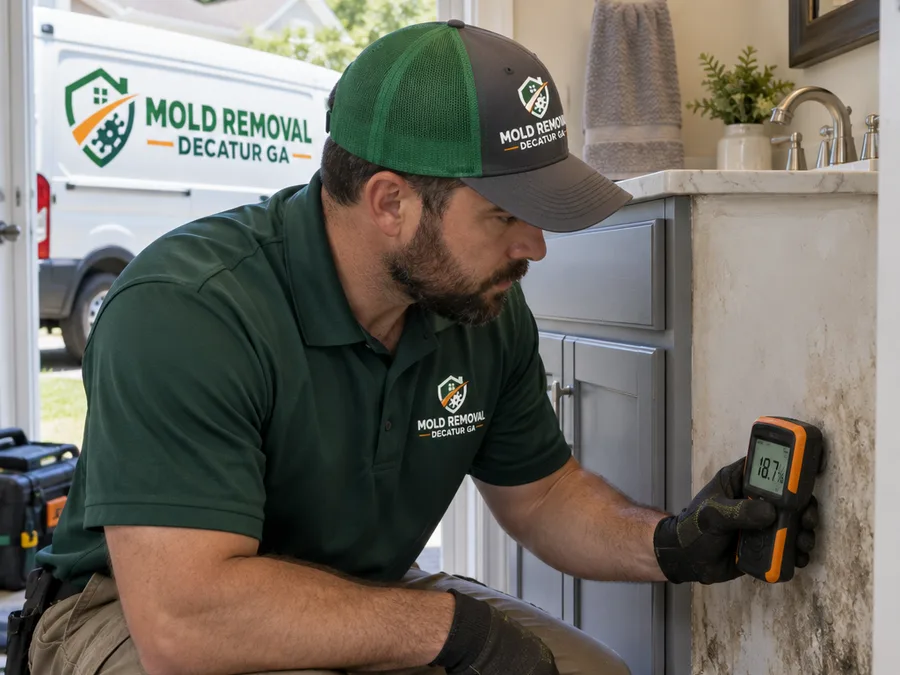
Moisture mapping: Pin and pinless meters measure drywall, wood and subfloor moisture so wet areas can be outlined.
Thermal imaging: An infrared camera shows temperature differences that often point to wet insulation or hidden leaks.
Sampling when useful: Air samples compare indoor spore levels with an outdoor baseline; tape or swab samples identify surface growth. All go to a third-party lab.
Written report: Photos, readings, lab results if taken, and a plain-language summary of what needs to happen next.
Sampling has limits. Air tests show a moment in time and can miss growth sealed inside a wall, so the moisture findings carry as much weight as the lab numbers.
When Decatur owners call
Pre-1960 homes near downtown Decatur and Oakhurst often have crawl spaces, past renovations and old plumbing worth checking before closing.
Smell without visible growth usually means a hidden source in a wall, under flooring or in the ductwork.
A roof leak or burst supply line can wet wall cavities that look dry from the room side.
Landlords and tenants use written findings to sort out what is present and what caused it.
Allergy or asthma flare-ups at home can be a reason to check for hidden growth, alongside advice from a doctor.
Four steps
We agree on what the inspection needs to answer, such as hidden growth, extent after a leak, or documentation for a sale.
The home is checked room by room with moisture meters and thermal imaging, including the attic, crawl space or basement.
Air or surface samples are taken only where results will guide the scope, with an outdoor control for air tests.
You get photos, readings, lab results and a clear list of what to remove, what to dry and what to fix.
Related services
Spread or recurring growth handled with negative air, HEPA detailing and a documented closeout.
Growth on joists and subfloor from damp clay and humid vents.
Foundation seepage, finished walls and musty carpet below grade.
Dark growth on drywall after a long leak, removed under sealed containment.
Leaks, burst pipes and storm water dried before mold sets in.
Roof sheathing growth from poor venting and bath fan exhaust.
Coils, drain pans and ducts that smell musty when the AC runs.
Growth behind tile, under vanities and on ceilings that keeps returning.
Common questions
Usually not. When growth is visible, the type of mold does not change how it is removed, so testing mainly helps when the source is hidden, extent is unclear, or a third party needs documentation.
Air sampling measures spores in the air and compares them with an outdoor sample to see if indoor levels are elevated. Surface sampling (tape or swab) identifies what is growing on a specific spot.
Often, yes. Moisture readings and thermal imaging point to wet areas, and a small inspection hole or wall-cavity air sample can confirm growth without opening the whole wall.
Many owners prefer a separate inspector so the findings are independent. Either way, ask for written findings with photos and readings before any removal starts.
A typical home takes one to three hours on site. Lab results from sampling usually come back within a few business days.
Tell us what you are smelling or seeing and why you need answers. We will set up an inspection that fits the question and give you written findings.