
Supply line and valve failures
Toilet, sink and washing machine lines can release a lot of water quickly, often while no one is home.
Serving Decatur, Georgia & surrounding areas
Open 24/7
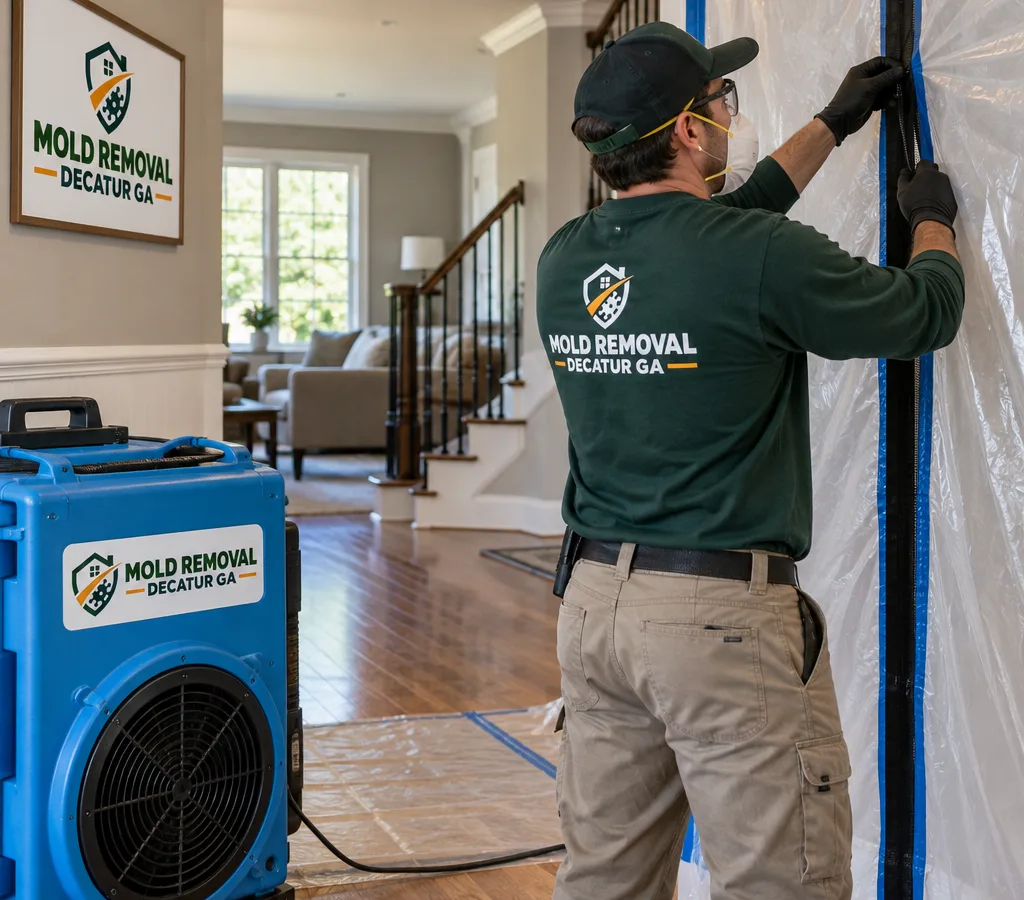
Water damage mold in Decatur, Georgia
Act within 24 to 48 hours of a leak, or clean out growth that has already started, and dry the structure before anything is closed up.
Answer first
Mold can start growing on wet drywall, carpet pad and insulation within 24 to 48 hours. Water damage mold work finds every wet material with moisture meters, removes what is already growing or cannot be dried, and runs drying equipment until readings return to normal. The goal is to stop a one-time leak from turning into a mold problem months later.
In Decatur, the usual causes are burst or leaking supply lines, failed water heaters, dishwasher and ice maker lines, roof leaks during summer thunderstorms, and freezing pipes on the rare cold snaps that hit north Georgia. Each one wets materials in a different pattern, so the source shapes the scope.
If growth is already widespread when you call, the job is planned as mold removal for Decatur homes with drying added, rather than drying alone.
Scope of the work
The plan follows the water, not just the visible stain:
Moisture mapping: Meters and thermal imaging outline how far water spread inside walls, under floors and into ceilings.
Removal of wet porous materials: Carpet pad, wet insulation and drywall with growth or long wet times are removed.
Cleaning of what stays: Framing, subfloor and hard surfaces are cleaned and treated once wet material is out.
Structural drying: Dehumidifiers and air movers run until wood and drywall readings return to dry standard.
Photos and readings log: Daily readings and photos give you a record for repairs and for any insurance claim.
Clean water from a supply line and dirty water from a sewer backup or outside flooding are handled differently, so the water source is confirmed first.
Decatur water events
Toilet, sink and washing machine lines can release a lot of water quickly, often while no one is home.
Tanks in closets, basements and garages leak slowly at first, soaking the base of nearby walls.
Heavy afternoon storms test older roofs, valleys and chimney flashing on Decatur bungalows.
Pipes in crawl spaces and exterior walls can split during hard freezes and leak once they thaw.
Heavy rain on clay soil pushes water into lower levels and along slab edges.
Four steps
The leak is shut off or repaired, and we confirm whether the water was clean, gray or dirty.
Moisture readings and thermal imaging show where water traveled inside the structure.
Growth and wet porous material come out under containment, then remaining surfaces are cleaned.
Drying equipment runs until readings are normal, then you get the log before walls are closed.
Related services
Spread or recurring growth handled with negative air, HEPA detailing and a documented closeout.
Growth on joists and subfloor from damp clay and humid vents.
Foundation seepage, finished walls and musty carpet below grade.
Moisture mapping and sampling when the source is hidden.
Dark growth on drywall after a long leak, removed under sealed containment.
Roof sheathing growth from poor venting and bath fan exhaust.
Coils, drain pans and ducts that smell musty when the AC runs.
Growth behind tile, under vanities and on ceilings that keeps returning.
Common questions
Mold can begin growing within 24 to 48 hours on wet porous materials such as drywall, carpet pad and insulation, which is why fast drying matters.
Sometimes. Drywall wet from clean water for a short time can often be dried in place. Drywall that has sagged, wet from dirty water, or already shows growth should be replaced.
Usually not. Fans dry the surface, but water inside the wall cavity and the bottom plate needs dehumidification, airflow into the cavity, and moisture readings to confirm.
It depends on the policy. Mold from a sudden, accidental leak is treated differently from mold caused by long-term seepage. Photos, readings and a written scope help when you talk to your insurer.
Shut off the water, turn off power to wet areas if it is safe, move items out of standing water, take photos, and start drying or call for help within the first day.
Tell us what leaked, when it happened and where you see damage. We will map the wet areas and set out what to remove and how to dry the rest.